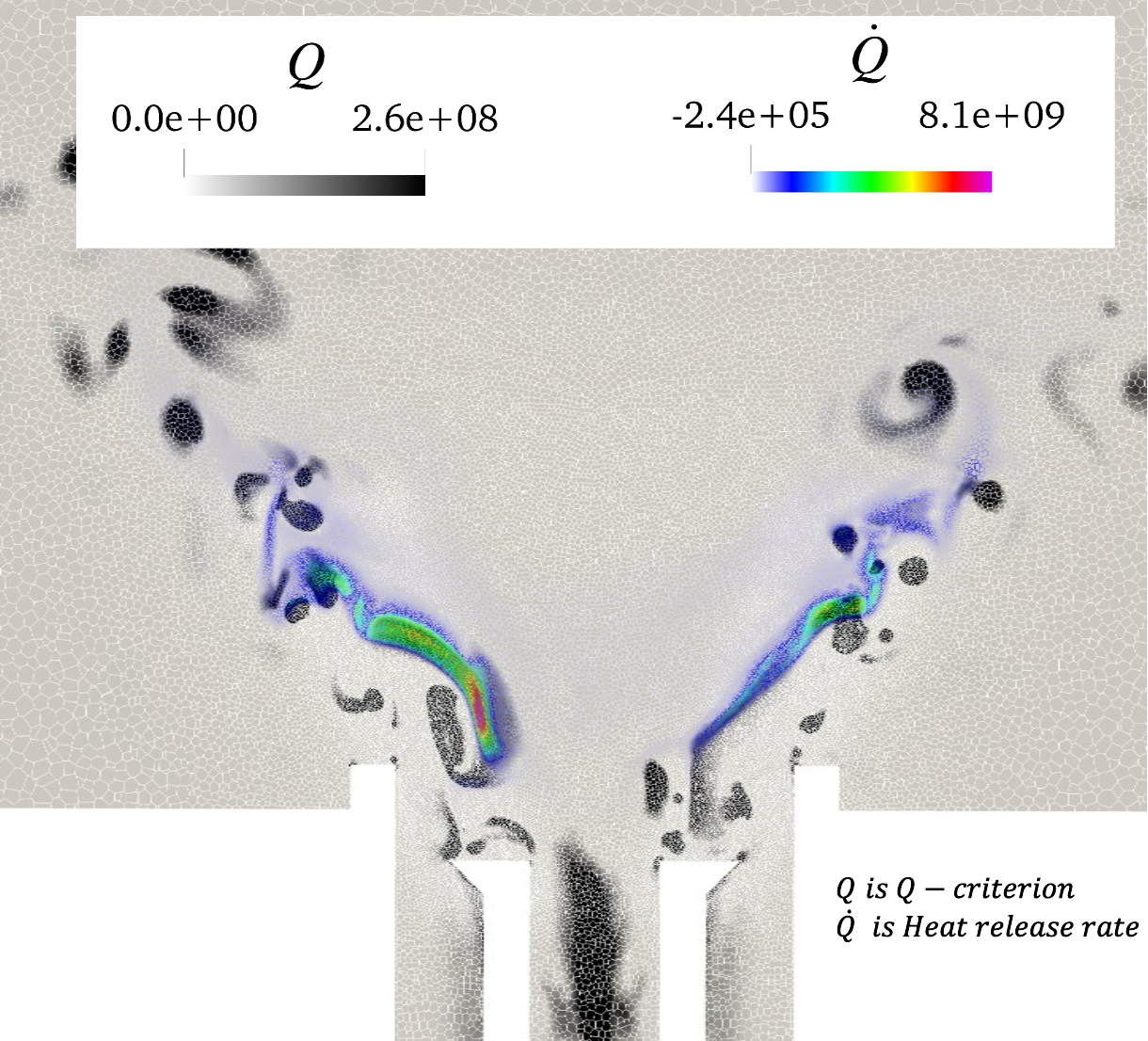
Burning fuel in industrial applications—like an engine or a furnace—is rarely calm and simple. Instead, the flames are often chaotic (turbulent), and inside them, the flow of gases and the chemical reactions that release heat are constantly influencing each other in complicated ways. This makes it very hard for computers to predict exactly what will happen.
The core challenge comes from two things working together. First, chemical reactions are highly sensitive: a tiny change in temperature or fuel-air mixture can dramatically speed up or slow down burning. Second, turbulence creates swirls and eddies of all sizes, from very large down to microscopic. To accurately simulate a real flame, a computer would need to track details across this huge range of scales—which is currently impossible with any practical amount of computing power.
Instead, researchers must use simplified models that ”fill in” the small-scale details that the computer cannot see. This is especially difficult for unusual burning conditions—for example:
- When fuel burns at lower temperatures (called MILD combustion),
- When fuel and air are only partially mixed before burning (partially premixed flames), or
- When the fuel contains a lot of hydrogen (hydrogen-enriched flames).
In these cases, the mixing and the reactions happen at comparable speeds, so we cannot simply assume one is much faster than the other.
Hydrogen is a promising clean fuel for industries that are hard to decarbonize. However, burning hydrogen introduces its own challenges: it spreads very quickly, behaves differently than other fuels in terms of heat flow, can easily lead to unstable flame patterns, and ignites over an unusually wide range of mixture strengths. In real industrial systems, hydrogen flames often shift between different burning modes—sometimes the fuel and air are perfectly mixed before burning, sometimes they are not mixed at all, and often it’s a mix of both. Classical models, which were developed for fossil fuels like methane, often fail in these situations.
To handle the interaction between turbulence and chemical reactions, researchers have developed two main approaches:
- Reactor-based models (such as the Eddy Dissipation Concept and the Partially Stirred Reactor model). These assume that most of the chemical reaction takes place inside tiny, isolated ”hot zones” scattered throughout the turbulent flow. The amount of these zones is determined by how fast mixing and reactions occur.
- Geometric or flame-surface models (such as the dynamic thickened flame model) can also be categorized as artificial thickened flame models. These describe how turbulence stretches and wrinkles the flame front, increasing its surface area, often using a mathematical rule (power law) based on how jagged the flame becomes.
Besides these, there are simplified chemical models (reduced-order models), but the most accurate results come from using the full, detailed chemistry within the two approaches above—though this requires more computing power.
Despite decades of research, important gaps remain in the tools available to the scientific community, especially in open-source software:
Implementation: The work will follow around the manual tuning, and the dynamic implementation of ”Partially Stirred Reactor” (PaSR), which recently exists mainly for RANS/LES simulations, and even then it often requires manual tuning to predict flames accurately when used. For premixed hydrogen flames it may work, but for partially premixed cases it requires manual adjustments (”empirical tuning”) that are not universally reliable.
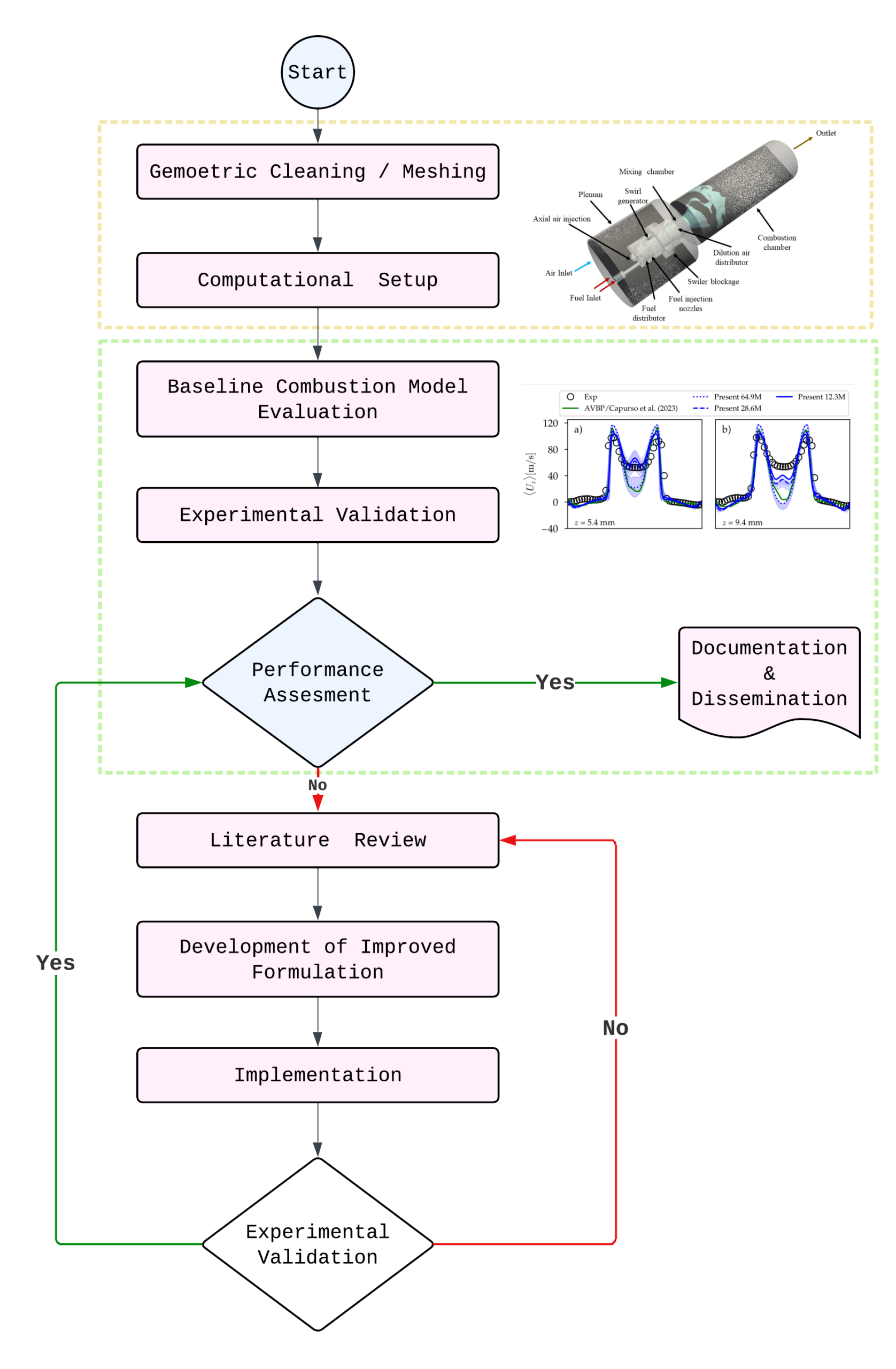
The key goals ahead are to properly implement and validate the model—especially for hydrogen flames—in open-source software and to test them across a range of conditions from simple laboratory flames to full-scale industrial systems. Accomplishing this will enable more researchers to accurately simulate hydrogen combustion, accelerating the transition to cleaner energy. The implementation will follow the following flow diagram to make the implementation work for multi-regime reactive flows.
The authors gratefully acknowledge the support of the FUUG Foundation, which enabled the presentation of these results at the HYLON Days event (April 28–29, 2026) in Toulouse, France, and attendance at the Combustion Symposium in Tokyo, Japan, from July 26 to 31, 2026. The implementation will be made publicly available following publication of the journal article.
Ali Haider sai Fuugin säätiöltä 2 000 euron apurahan PaSR-mallin parantamiseen teollisuusmittakaavan sovelluksissa.
Fuugin säätiö jakaa apurahoja avointen tietojärjestelmien ja avoimen lähdekoodin ohjelmistojen kehittämiseen liittyvään työhön. Säätiön jatkuvaan apurahahakuun voi jättää hakemuksen milloin tahansa. Sama hakija tai hanke voi myös hakea avustusta useita kertoja.